Acknowledgement of Country

We acknowledge the first peoples of the lands on which we gather, make, learn and be, and pay our respects to Elders past, present and emerging. Recognising their continuing connection to land, water, sky, and all Earthian kin on this beautiful planet we are born of.

A provocation and invitation

Everything presented here is both provocation and invitation—to imagine how we might craft flourishing futures together.

Start a Circle

Gather a few people. Sit together. Listen deeply.
That's where everything begins.

Here's how

When was the last time you cried with someone?

Most of us can't remember. We've lost the spaces where we can be fully human together — where grief, joy, confusion, and hope can all be held. A circle is the simplest technology for remembering how to do this. People have been doing it for tens of thousands of years.

What is a circle?

A circle is 3–7 people who gather regularly to be present together, listen deeply, and sense what wants to emerge. It's not a committee, a book club, or a support group — though it can hold elements of all these. It's the oldest form of human organising, and the foundation for everything that follows.

In a circle, there's no audience and no stage. Everyone is both speaker and witness. Hierarchy dissolves. And from that shared presence, something becomes possible that wasn't before.

Start yours this week

You don't need training, certification, or permission. You need a few people and a place.

1. Invite 2–6 people

Neighbours. Friends. Colleagues. People you sense might be ready for something deeper than small talk. Send a simple message: "I'd like to try gathering a small circle to be present together, share what's alive in us, and listen. No agenda. Interested?"
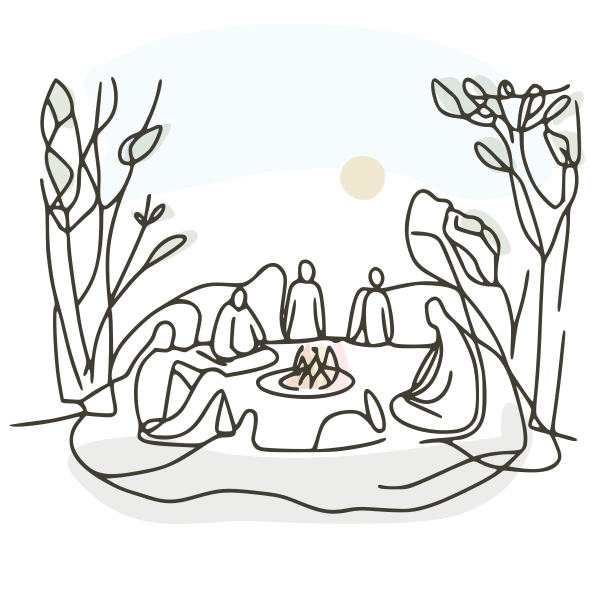

People sitting in a circle around a fire in nature
Tapestry of life illustration showing interconnected threads

2. Choose a place

Your backyard. A living room. A park bench. A community garden. Somewhere you can sit facing each other without distraction. Outdoors is wonderful if you can. The land is part of the circle too.

3. Pick a rhythm

Weekly is ideal. Fortnightly works. Monthly is the minimum for trust to build. Same time, same place. Consistency is what turns a meeting into a practice, like a heartbeat that the group can rely on.


Illustration of patterns emerging
Illustration of many circles gathering

4. Gather and begin

Arrive. Settle. Breathe together. Then use the simple practice below. That's it. No preparation needed beyond showing up with an open heart.

Presencing Circle

45–90 minutes · no materials needed

This is a starting point, not a script. Your circle will find its own rhythm. Trust the process.

  1. Arrive together — Sit so everyone can see everyone. Take a minute of silence. Feel your feet on the ground. Notice you're not alone.
  2. Set a simple intention — Someone says: 'We're here to get present together and see what wants to emerge.'
  3. Share the guidelines — Welcome whatever shows up. Speak from what's alive in you right now. Listen with your whole being. Let there be silence between speakers.
  4. Open with a question — Try: 'What's alive in you right now?' or 'What are you carrying that you'd like to set down here?' Let each person speak without response. Simply witness.
  5. Let conversation emerge — After the opening round, let things flow naturally. Speak when moved. Don't rush to fill silence — the spaces between words hold something too.
  6. Close together — Go around one more time. Each person shares one word or phrase that captures their experience. Then a moment of silence to honour what was shared.

There's no facilitator needed — though someone might naturally hold the rhythm. Rotate this role if it emerges. The circle is the teacher.

Six things that help a circle thrive

Welcome whatever shows up

Grief, joy, confusion, anger, silence, laughter. None of it is wrong. A circle that can hold the full range of human experience becomes a place where real things can happen.

Speak from what's alive in you

Not theory, not opinions about the news — what you're actually feeling and experiencing right now. This is the shift from talking about life to being in it together.

Listen without fixing

When someone shares, your job isn't to solve their problem or offer advice. Your presence — your full, quiet attention — is enough. Being witnessed is its own medicine.

Let silence breathe

Pauses aren't awkward — they're where things settle and deepen. Resist the urge to fill every gap. Some of the most important things in a circle happen in the quiet.

Keep it consistent

Show up even when you're tired. Even when it's raining. Rhythm builds trust, and trust builds everything else. Three people who keep showing up will create more than thirty who don't.

Start small, stay patient

The first few gatherings might feel tentative. That's normal. You're growing something alive. Root systems develop in the dark before anything becomes visible above ground.

What grows from here

A circle is complete in itself — it doesn't need to become anything else. But when circles develop trust and rhythm, possibilities naturally emerge.

Shared projects emerge

A circle might start a community garden, organise a street gathering, launch a repair cafe, or tend to a local waterway. Action flows from relationship, not obligation.

Circles find each other

When circles in the same area connect, something larger starts breathing. Shared resources, cross-pollinated ideas, collective responses to local challenges.

Healing deepens

As trust grows, what people bring to the circle deepens too. Grief about the state of the world. Old wounds. Fears for children's futures. Held together, these become fuel rather than weight.

New imaginings arise

Groups that have grieved together and built trust can imagine together in ways that isolated individuals cannot. The future stops being abstract and starts being something you craft with your hands and hearts.

Questions you might have

"I'm not a facilitator. Can I really do this?"

Yes. A circle doesn't need a facilitator — it needs someone willing to send the first invitation. The practice itself does the holding. You're not leading, you're hosting. Think: inviting friends for a meal, not running a workshop.

"What if nobody comes?"

Two people is a circle. Start there. The smallest mycorrhizal networks begin with a single connection between two root systems. That connection, tended consistently, is how forests communicate.

"What if it gets emotional or intense?"

Good. That means something real is happening. You don't need to be a therapist. You need to stay present, keep breathing, and trust that the circle can hold what arises. People are more resilient than we give them credit for, especially when they're not alone.

"How is this different from a support group or book club?"

A support group has a problem to solve. A book club has a topic to discuss. A circle has no agenda except presence. You're not trying to fix anything — you're rebuilding the basic human capacity to be together in a way that's real. Everything else grows from that.

"What does this have to do with the future?"

Everything. The quality of our collective decisions — about climate, governance, technology, how we care for each other — depends entirely on the quality of our relationships. High-quality shared attention precedes high-quality shared action. This is where that attention gets built.

"Is there a broader network?"

Collective Futurecrafting is a growing web of circles, practices, and people working to craft flourishing futures together. Your circle is part of this whether or not you ever connect with anyone else. But when you're ready, the network is here. Share your story with us — we'd love to hear what emerges.

The only thing needed is your willingness to begin

You don't need to understand all of Collective Futurecrafting. You don't need to have read the right books or attended the right workshops. You need a few people, a place to sit, and the courage to ask: what's alive in you right now?

Join the network